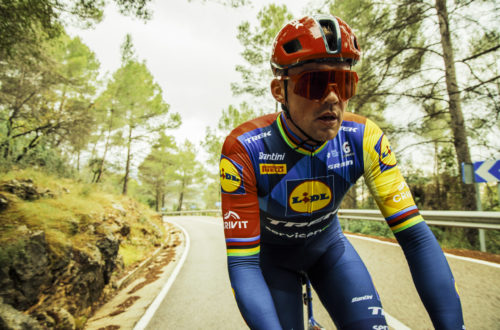

Ahead of the Opening Weekend, former professional rider and Lidl-Trek sports director, Gregory Rast, gives his advice for reading the cobbles
In the spring of 2003, on a grey drizzly Sunday morning in Belgium, 23-year-old Grégory Rast stood on the startline of his first ever Tour of Flanders. Over 250-kilometers of brutal bike racing over bergs and cobbles awaited him. Later, the story of that year’s edition was written through a controversial and historic battle for victory between Frank Vandenbrouke and Peter van Petegem, while neo-pro Rast would not play the role of even a minor character. He didn’t make it to the finish line in Meerbeke and, as he openly admits over two decades later, he had “absolutely no knowledge of what [he] was doing.”
So much in professional cycling has changed since the early-2000s that the sport, in many ways, is barely recognisable. Tires are wider, bikes are faster and technology is more advanced, but when it comes to the Classics, plenty has stayed the same. The brutally steep slopes of the Koppenberg, the Oudenberg chapel which sits proudly at the top of the Muur van Geraardsbergen and the dead-straight, fearsome Arenberg trench in Paris-Roubaix, still serve as the stadiums where greatness is born.
In his 15-year career as a bike rider, Rast learned how to play in these stadiums. He developed from a clueless neo-pro to one of the most respected Classics riders of his era by the time he reached retirement in 2018, and now passes his knowledge of the game forwards as a sports director for Lidl-Trek. The key to Classics success, Rast believes, is not just a rider’s physicality, but their mentality.
You need to really want it. If you don’t want it, it’s better to stay home.

“It needs to be your season goal, you need a lot of motivation to do it because these races are so hard and dangerous. This makes the most difference, you need to want to fight for position, want to race on the cobbles, be really into it,” he says. “For example, I’m one hundred percent sure that skinny, Ardennes riders could also win Flanders but they’d have to really want to do it.”
Being committed during the races themselves is only one piece of the puzzle. Rast argues that learning tactic and technique comes from being a student of the sport too. He encourages riders to rewatch previous editions of races like Flanders or Roubaix (Rast finished in fourth place in the Hell of the North’s 2011 edition) and complete multiple recons of the courses to know every pinch point and every gutter – this is imperative to understanding the task in hand.
The advice we give to young riders is for them to make their notes. In the end, we are in Belgium for three weeks and we always do the same climbs from different approaches.
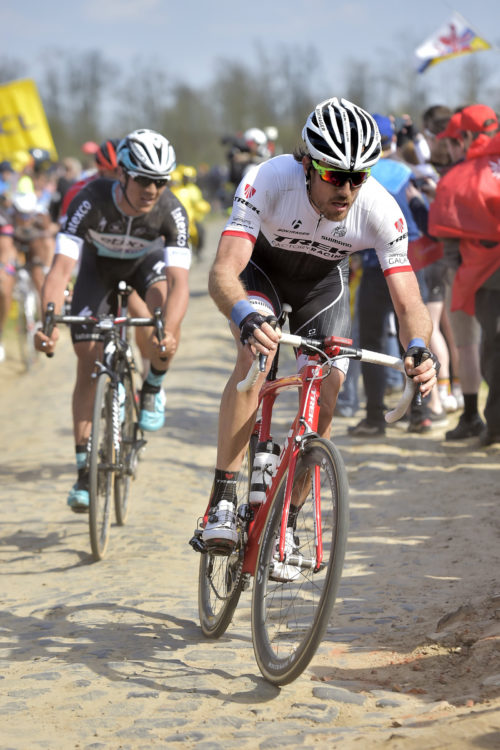
“If you start to make your notes then you have it much easier when you come back the following year. If they just come and ride the race then go back to their room and go on TikTok then it’s not good. If they really want to be a good Classics rider they need to know the parcours, this is a big part of it. We try to push them to make notes and be really into it,” Rast explains.
“When I was still a rider on the Saturday before the race I would always sit in my room and watch Flanders from the year before. I know guys like Eddie Theuns are watching the race from last year to understand the mood and see where things happened, where people went. Guys like Mads are interested, they do the recons and know what is coming.”
Although the routes of races like Flanders and Roubaix don’t change much each season, one thing that can’t be predicted is how each team will approach them. Recent years have seen riders make far-ranging attacks from unexpected points in the course, meaning everyone has to be on high-alert for dangerous moves as soon as the flag drops.
“In the past it was quite easy to read the race because the teams had one guy at the head of the race, for example it was Tom Boonen or Fabian Cancellara. When they weren’t at the front yet, nothing happened and their teams used to wait and wait. This has changed now as we have riders who don’t need to wait. They can go early,” Rast reflects.
“Seven or eight years ago more teams started to have multiple riders who could win and they all wanted to be the first rider on the attack so they could play the game on the offensive, not defensive.”
We saw when Mads finished second last year he attacked with more than 100-kilometers to go and didn’t stop. It becomes a head-to-head competition between the leaders early now.

Being in the right place at the right time is imperative to ensuring that the team doesn’t miss the move at crunch time: “Positioning is the most important. Some guys are in position when it doesn’t count and aren’t there when they should be, then they have to make a huge effort to fix it. Everyone knows in E3 Saxo Classic, for example, you need to be at the front before the Taaienberg. I wouldn’t even call it a mistake if you’re not there because it has a lot to do with the legs. When you have good legs, you’ll always be where you need to be and if you have a good team, you’ll always be in position,” Rast says.
Having a line-up for the Classics which balances both youth and experience is something that Rast tries to strike at Lidl-Trek. Young riders might have the hunger and abandon to fight for every position at key moments in the races, but experience is also needed in behind them to ensure that energy isn’t wasted and that the team stays calm when they need to.
“To have success now, you need to have a mix [of ages]. You need guys like Edward Theuns and Otto Vergaerde who know the races and the situations, but you also want to bring up young riders.” Rast explains.
“For example, Jakob Söderqvist is physically fantastic for these races but he is young, so may suffer a bit with the experience. Someone like him needs to come into the Classics not to be a leader but to see what it is about. Many of them are really surprised after Opening Weekend because they can’t believe how different these races are to what they do for the rest of the year. It’s important to have leaders like Mads, Vacek or Milan but we also need to start to work with younger guys so they can get a little bit of a taste of the Classics.”
There are few people better qualified to guide Lidl-Trek through the chaos and carnage of these legendary races than Rast. He admits that he had no idea what he was doing when he first made his Flanders debut as a rider 23 years ago, but he has since become a master of the cobbles. This comes after two decades of studying the quiet, unsuspecting roads of Northern Europe which have shaped the history – and will shape the future – of bike racing