
In an in-depth interview, the Spanish rider discusses growing up, dealing with setbacks and the importance of enjoying the journey
A nine-year-old Juan Ayuso stands on one of Alpe d’Huez’s 21 hairpins with his eyes wide open. Right in front of him, in a flash of yellow, the likes of Andy Schleck and Alberto Contador are battling up one of the most fabled and revered mountains of the Tour de France. Head-to-head, mano a mano, the two men are at the peak of their powers. Majestically athletic superheroes pushing their physical limits like animals. Little Juan, as he watches them fly past, is almost daring to dream.
While he can’t quite yet imagine himself as one of these mythical bike riders, he knows he felt something that day which would shape his life to come. Those mountains, the bikes, that grit, glory and suffering, unlocked a small pocket of hope and ambition in Ayuso’s developing psyche. Ever since, he has been following that feeling.

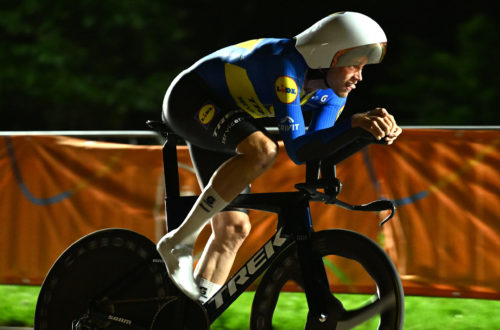
14 years on from his childhood summer day on the Alpe, a 23-year-old Ayuso sits in front of me and looks every bit the professional cyclist. As we glance at photos of him at the Tour as a kid, squinting at his dad’s camera wearing a baggy t-shirt, it’s hard to imagine he is the same person. His body is now perfectly-conditioned through years of careful fueling and hard training, and his mind has matured to be focused and sharp. A thoroughbred sportsman. There are now just seven days to go until the 2026 Tour de France begins in Barcelona, Spain. Ayuso will start the race as his team’s general classification leader in his home country. This is the big time.
The journey to this point has been a whirlwind for the Spaniard, who has been forced to ride the rollercoaster of the unpredictable sport that is professional cycling. In this season alone – his first as a member of Lidl-Trek – there have been ups and downs. The win in Volta ao Algarve started things off on a high, and the third-place podium spot at Tour Auvergne-Rhône-Alpes is a happy recent memory, but in between those results, Ayuso has dealt with sickness and injury. He admits he is getting used to rolling with the punches.
“I’ve always had quite a few setbacks all throughout my career, and when I am struggling I always go back to the worst time in my career which was when I was injured in 2023. That makes everything feel like it’s a bit less dark and I manage to take the positives of the current moment,” Ayuso says.
This team has helped me a lot on that side, they don’t put any pressure or stress and they understand that I am the first person who wants to be there winning races. If I can’t, it is because I need to stop and recover.

The two-time Vuelta a España stage winner has curated a balanced outlook on his career: “Cycling is just like life. Sometimes, you work really hard and it’s really nice, but then it can go away in a second. But that’s also the same for a person with a normal job, you can work hard and not get paid for the outcome. Before I crashed earlier this year, I had my best feelings and numbers ever. That has given me the motivation to get back there again.”
Ayuso undoubtedly has the mindset of a champion. This is imperative to help him deal with his self-imposed insatiable desire to perform – a feeling he’s had felt since he started winning bike races as a teenager. It has taken some time to realise where his priorities should lie, but the Spanish rider believes he has grown up fast over the last few years. He is sure that when he looks in the mirror today, he sees the best-ever version of himself.
“I grew up being called the big star, the new thing. When you’re young, you also start to believe it. That leads to all your happiness being tied to results. But the reality is, you lose much more than you’re going to win, so your happiness needs to be related to how you prepare yourself and give the best you can every day.”

Image: Sean Hardy
He is learning to enjoy the process of getting ready for big races like the Tour de France, rather than solely focusing on the outcome.
“It helps to take away the pressure. Now I gain fulfilment from the work I do every day, which means my happiness doesn’t depend as much on what happens in the race. Like, before Paris-Nice, I did everything I could to try and win. I was doing the best numbers ever, but I crashed at over 70kmp/h because there was oil on the road,” he remembers.
“That was out of my control, but the preparation is what I can control, so I focus on that. It helps if I go to a race knowing I have done everything I can with the circumstances I have, then I just give my best effort.”
In order to build a life he is happy with, even when victories aren’t coming like he hopes, Ayuso’s close support circle is crucial. His parents have encouraged him ever since he decided that bike racing was his big dream, and their belief in him has never wavered. While doing everything to help him get to where he is, they have also ensured he keeps his feet on the ground.
“I’m lucky that my family is quite a normal family. They don’t get carried away. They’re happy for me if I get good results, but when I come back home, it’s to a normal house. I get told off if I leave things on the table, for example, and that’s how it’s been forever,” he says with a smile.
When I was racing in the younger categories, my parents made sure I knew that my studies were more important than cycling. I think that helps to remind me that cycling is not everything in life and there is much more than just what I can achieve on a bike against 200 other guys. It’s not the end of the world if it doesn’t go the right way.

Image: Sean Hardy
Unlike in the past, Ayuso says he has learned to only take note of opinions coming from the few who know him best. External noise and conversations about him are simply distractions from the processes he wants to focus on. Blocking out the negative voices is something that the Spanish rider finds crucial in the approach to big races.
“When I started being professional, I think I read everything that was written about me. Each time I got bad press I started thinking: ‘why is my happiness depending on someone who doesn’t even know me as a person.’ In the last two or three years I’ve got better at blocking it out. It still affects me obviously, as no one likes people saying bad things about you – especially when they are not true – but it bothers me much less than before. If someone I know speaks badly about me, then that would matter more than anything, but outside that I keep myself protected and isolated.”
Trust is something that Ayuso holds in high regard and he has found plenty of it in his first year as part of Lidl-Trek. From his soigneur, to his coach, to his nutritionist, to his teammates, there is unwavering support for the 23-year-old as he chases his dreams. This goes far beyond a normal job description; those who Ayuso works with are his friends as much as they are colleagues. These relationships are key to ensuring he is happy while doing his job, something which should not be estimated in the strive for success.
I’ve had problems this year, but the team has always been there. It is very human and always understood each situation I was going through. There are now a lot of changes with management, but it’s growing in a positive way. As a rider, I feel that we are on similar timelines. We’ve both proven a lot, but we still need to grow. I think it’s really beautiful to work on this together.

Image: Chris Auld
Ayuso has developed close relationships with many of his teammates too. Up-and-coming talent Hector Álvarez is one of his good friends, while Spanish veteran rider Carlos Verona has been a steady voice of advice and reason. Ayuso has learned to work well alongside fellow climbers like Derek Gee and Mattias Skjelmose at stage races already this season, and believes that this can be an asset to the team during July’s Tour de France.
“We saw in the Dauphiné that when me and Skjelly are together we can use our strengths. When we aren’t together, it’s always a positive to have one guy in the second group in case it comes back together and then you have more options,” he explains.
“It means I don’t feel like all of the pressure is on my shoulders. At the Tour, this is also the same with Mads [Pedersen] who is also going to be a key player fighting for green and stage wins. It takes a bit of stress away, like at the Dauphiné when I had two second places I was a bit hurt, but the stage win of Quinn [Simmons] helped the whole team keep believing. I hope at the Tour we can win a stage with Mads early as it helps us manage things a bit more calmly then going forwards. Ultimately, I need to ensure I keep performing right until the last week.”

Image: Sean Hardy
Ayuso is quick to point out that this year’s Tour de France is only the second edition he has ever competed in. He was unable to finish his first attempt in 2024, so the feeling of arriving at the Champs-Élysées in Paris is still alien. Being unsure what to expect means that Ayuso might lack some experience, but there is also a type of excitement in not knowing where the ceiling is for this ambitious young rider. From windtunnel testing, to altitude camps, and all the long hours on the bike in between, the Spaniard has thrown everything at being his very best he can when the Tour begins in Barcelona.
“Preparation and everything invested from the team is just at a different level for the Tour compared to any other race on the calendar. My goal is obviously to be on the podium in Paris, but I have had setbacks and I know it is going to be three weeks of tough racing. You work so hard training away from the cameras when no one can see you, so I am excited after two months of preparation to have the chance to show it when everyone is watching,” he comments.
On stage 19, Ayuso will climb Alpe d’Huez as part of the Tour de France peloton, living a life he dreamed of as a nine year old when he watched Contador, his idol, dance over the slopes of the mountain. He’ll dig deep on those hairpins thinking of the bright-eyed boy who would have been so grateful to have the opportunity to be there at all. Ayuso believes in himself – he has to if he is going to perform – but with an awareness that his value is far greater than what he can do on a bike. The last few years have been about growing up and realising that joy must also be found in the journey.
“I’m paid to perform, I won’t forget that. But I have the confidence that when I have worked hard enough, and when I have done everything that is in my hands to ride the best possible race, I know I have the talent,” he states. “I believe that the work I have done is going to pay off.”
Watch All Access: Project Juan 📺🍿 to get to know Juan Ayuso even more!
Warning: Undefined array key 1 in /home/clients/7518b61c62c70d25a612562cfee0dace/sites/racingtrekbikes/wp-content/themes/trek/functions.php on line 446
Warning: Undefined array key "host" in /home/clients/7518b61c62c70d25a612562cfee0dace/sites/racingtrekbikes/wp-content/themes/trek/functions.php on line 454
Warning: Undefined array key "host" in /home/clients/7518b61c62c70d25a612562cfee0dace/sites/racingtrekbikes/wp-content/themes/trek/functions.php on line 454
Warning: Undefined array key "host" in /home/clients/7518b61c62c70d25a612562cfee0dace/sites/racingtrekbikes/wp-content/themes/trek/functions.php on line 454