
The story of a crash, a comeback and one of the most determined bike racers of this generation
“Michi, if my back is broken you will never see me ride my bike again, I’m done. I’m finished. You can keep my jersey. That’s it.”
It is February 4th and Mads Pedersen is staring at the roof of an ambulance, saying these words to his sports director, Michael Schär. His neck is in a brace and he’s sure his wrist and collarbone are broken. He feels sharp pain in his back from hitting the tarmac on the opening stage of Volta Communitat Valenciana while travelling at 60kmp/h. It was the kind of fall that knocked all the breath from his body.
Before this fateful day in Spain, it was all going to plan. The work had been done over the winter, there had been no stress, no sickness. The numbers at training camps had been good – excellent, even – and Pedersen was ready to chase his first Monument victory for another year. It took just a few, fleeting seconds for everything to change.
“I was lying on my stomach and I tried to push myself up by putting my hands on the ground, but I couldn’t. Straight away they came to me because I was face down.”
Michi was in the ambulance with me and he didn’t cry, but it was emotional for him as well. They took me to the hospital and luckily the back was not broken.

Pedersen is now speaking two months after he lay in that hospital bed questioning not only how the rest of his season would look, but if he’d be able to race again this year at all. He’s already deep into his comeback, which started with a fourth place at Milano-Sanremo in March (just over one month after the crash), and continued with top-10 finishes at E3 Saxo Classic, Dwars door Vlaanderen and the Tour of Flanders. The speed in which he has returned to the peloton is, by any standards, miraculous.
While his back was not broken in Spain, the accident left him with a complicated wrist and collarbone fracture. Healing his shattered bones has been the sole focus of the Danish rider’s life for the past 60 days. To crash on the first race day of the season after a seamless winter is a stroke of fate so cruel that Pedersen would have been forgiven for taking a few days to wallow in self-pity at the hand he had been dealt. But this is not the man he is.
“The crash was on Wednesday and on Friday I had the operation. By Saturday evening I was on the phone to my coach and I told him: ‘Okay, how are we going to make it back?’ He told me to take it easy at first and we’d do whatever we could do. The problem was I had the left arm in a cast to my shoulder and the right collarbone was broken. I had pain in my back from lifting the cast all the time, it was so heavy,” Pedersen recalls.
For the first few days of his recovery, riding a bike was not an option, so the former world champion took to walking up and down the stars to keep active. He then sat on his Wahoo trainer with both arms resting on boxes either side of him. As soon as he could, he started two indoor sessions per day on the bike of an-hour-and-a-half.
“I didn’t work the whole winter to throw everything away,” he says with a grin.
I knew if the progress was good, I could start believing in coming back to the races and being good in the Classics.

In order to truly understand who Mads Pedersen is, and why setbacks like that crash do not stop him, but simply drive him forward, we need to look back to the people and places that made him.
Zealand is a large island that is part of Denmark. It’s home to the capital, Copenhagen, and the city of Roskilde. Small towns and villages occupy the north, south and west coasts, and Tølløse is a railway town located in the northwestern part of the island. Pedersen grew up there with his parents and brothers, learning his trade in hardy, cold and brutal winter conditions. Ever since his cycling career began, the 30-year-old has been characterised by his resilience. He thrives in bike races at the exact moments when those he is competing with start to give up. Give him rain, wind, hailstones. Give him seven hours of relentless attacks. The tougher, the better.
“I think I get this from my mum,” he states. “She’s a tough woman. I think it’s in her genes, I got most of it between me and my brothers. I think it comes from the toughness of my mum and seeing her commitment to life. Even at an older age she has started to do new studying and achieve new goals which is something nice to see from a woman who is 50-years-old spending her time like that. I hate it when people feel sorry for themselves, it’s just horrible.”
If you can change it and make an effort to be better, just do it. Sometimes life is a pain in the ass and it’s not your fault, but if you can change it, you have to.

Pedersen is not ashamed to admit that his family and those close to him have been integral to making his comeback possible. Although a lot of his strength comes from his own steadfast mindset, he knows he couldn’t do this alone.
“My whole team was incredible. The commitment to get me to Belgium and have the operation and move everything as fast as possible to start the recovery was insane. I had my mechanic in Mallorca to rebuild bikes every third day to get me closer to a normal position, my own soigneur was with me the whole time. My wife supported me throughout, never questioning what I was doing and just giving me full trust. My dad was doing motorpacing for me. In general, I found out why I love this team and why I have a contract here until the end of my career. In these moments, they show their loyalty and we stand up for each other,” he says.
It is in his last sentence that Pedersen sums up why being part of Lidl-Trek works for him. The relationship runs deeper than just that of a rider employed by a team – it is based on trust, belief and communication. Decisions like Pedersen’s early and unexpected comeback to race in Sanremo, for example, are made together as a result of constructive conversation. The Danish rider does not feel pressure from the organisation he represents – his drive to improve is intrinsic.
“When I am racing, I’m the one who puts the most pressure on myself. I want to win, I work my ass off to win and I don’t do this for anyone else. I’m not doing it to make my parents or wife happy. I really couldn’t care. It’s a goal for me,” Pedersen states.
“Maybe that’s my big ego or self-confidence but it really is me that motivates me. On the way to success, you also have to fail and maybe you fail under pressure, but I learn from that.”
I have these things I want to achieve in cycling and I’ll never settle until I can do that. That’s my drive. I love to win.

Pedersen’s confidence, combined with his insatiable appetite for success, makes him the perfect leader to motivate those around him. It’s clear when the Dane walks into a room that everyone sits up and listens. He has a way of commanding attention, making everyone buy into his plan, no matter how crazy it may seem.
“I wasn’t born with this [ability to be a leader], but I’m really interested in other people. I find it peaceful to look at people and see how they behave, what they’re doing. If you take interest in this then you learn how to deal with different cultures and personalities,” he explains.
“The moment you start to understand that, then you also grow as the person everyone is believing in because you treat everyone with the same respect. You find a balance in how to talk and motivate people. The team meetings we have before races are only the last two percent of the work I do to be a good leader.”
Of course, his teammates’ trust in him comes from the victories Pedersen has had in his career so far too. There is the 2019 World Championship, the Grand Tour victory trifecta, the three Gent-Wevelgem wins, the Roubaix podium and the second place in Flanders last year, to name just a few of his successes. This is a rider who always delivers on the work others do for him, especially in the races which suit him best. Despite all he has achieved so far, however, Pedersen is far from satisfied with his career. He still is adamant he will not settle until he wins a Monument, and believes Paris-Roubaix is his best chance.
I won it as a junior and it’s the Monument that fits me best. It’s the race I can dream of winning.

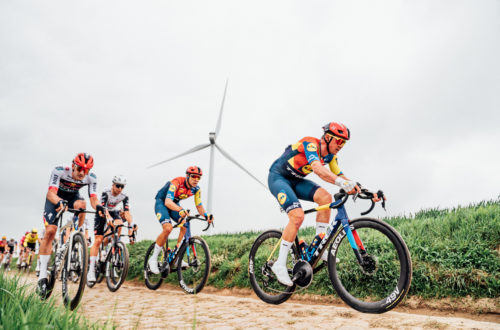
If we were going to personify Mads Pedersen in a bike race, Roubaix would represent him best. Those brutal cobbles of Northern France are made to be ridden by the hardest of souls. They are harsh on the mind and body. It is a race where anything can happen, it honours those who fight and never give up. In many ways, everything in Pedersen’s life up until now has been preparing him to win in the Hell of the North: those training rides in Danish wind and rain as a teenager, the stoic, resolute mindset he inherited from his mother, the hours sitting on the turbo trainer with his arm in a cast, have all led to that Sunday in April where the dream could finally come true.
If you consider the disrupted start to the season Pedersen has had, you might count him out of the fight for a Monument this spring. But if you were to count him out, you would be failing to understand the type of person Mads Pedersen is. He is a special case.
“Roubaix is ruthless, it’s tough, and that’s what attracts me to it,” he says. “It’s stupid, it makes no sense, but sometimes I like what is not normal. It’s a ridiculous race, and that’s why it fits me.”
Words by Rachel Jary
All Access: Road to Roubaix with Mads Pedersen