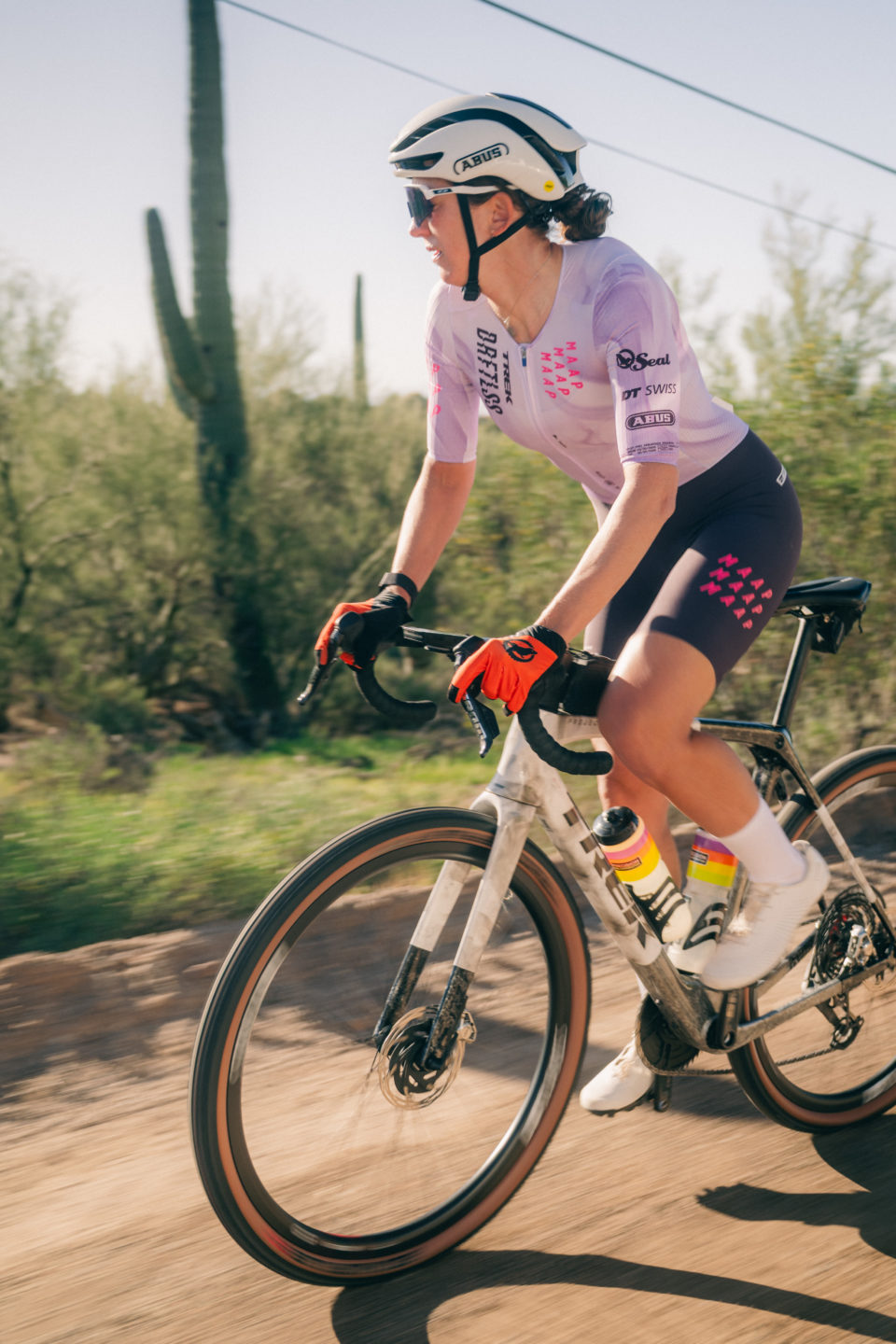

Lauretta Hanson and her nutritionist, Nicola Moschetti, discuss the evolution of fueling strategies, finding balance and avoiding comparisons
In Lauretta Hanson’s first race as a professional cyclist, she ate one gel per hour, containing around 20 grams of carbohydrates. This was long before the days of high-carb wonder-products that have now been brought to market. Back then, Hanson, like many of her colleagues, thought 20 grams was enough. Fast-forward ten years and the Australian rider now fuels with almost six times that amount of carbohydrates per hour in a race.
Her nutrition strategy could not be more different.
“I was always aware that I needed to fuel well, and I’ve been fortunate to have good people around me to really reinforce that, but how much I needed is what has really changed. I’ll easily have 120g an hour in some Classics, but that’s also only possible because of the advancement in nutrition that makes it easy to digest and absorb,” Hanson reflects.
It isn’t only during races that the 31-year-old has taken a fresh approach to nutrition as her career has progressed: “Fueling off the bike has also changed a lot and with it so has my awareness of what is in the food I’m eating and how it will help me to perform. I would always have a nice balanced plate, but it wouldn’t have anywhere near enough carbs for an endurance athlete,” Hanson says.
I don’t know if I believed in it, but fasted sessions used to be commonplace in my training, whereas now there is no way I’m going out without a good breakfast and food in my pocket.

The Australian woman hasn’t made these changes alone. She admits that they have come from increased knowledge and education around how much food she needs to be eating thanks to experts in the field. Her nutritionist at Lidl-Trek, Nicola Moschetti, is crucial to bolstering Hanson’s confidence that she is fueling correctly.
“The most important thing in our jobs as nutritionists is good communication with the riders. Without that, our work is a waste of time because we lose trust from the rider. We calculate everything and all the macronutrients but that’s not just for the sake of having them, it is to help riders trust in the process of working over a long period,” Moschetti says.
While we want to achieve the perfect body composition – low fat mass, good muscle mass – the trend needs to be slow and steady.

Part of Lidl-Trek since the women’s team’s inception in 2019, Hanson has seen first-hand the developments in the nutrition department each season:
“We gained more resources; I learned more and worked more closely with team nutritionists. I went from having a general idea of ‘I’m racing tomorrow, I need to eat a lot’ to actually knowing what I needed to eat – more easily digested carbs and less fiber etc,” Hanson states.
“If I look back at the beginning of my career I really notice the difference in my feelings and performances. In my first years with the team, I raced a couple of week-long stage races, and I remember feeling absolutely broken and empty after about four days. Now, I’ll get through the Giro or Vuelta and it definitely hurts, but I can back up on day eight and still have the energy to perform. Fueling doesn’t just help the effort on hand, but also how you recover, adapt and show up the next day. Ultimately, everything is very measured and precise now, but I have a far greater awareness of what fuels my body to perform.”

Moschetti is a former professional volleyball player who had his own struggles with weight during his career. His personal experiences help him strike a healthy balance between instructing the riders he works with what to eat, but also knowing when they need to be able to make their own decisions. It is not about control, but about empowering riders, empathising with them and helping them to feel happy and healthy.
“A big part of my role is also about education and helping Lauretta be autonomous when there are some changes in the last moment because of an unexpected race scenario, for example,” he explains.
“I always support her in the best way possible but the fueling plan reflects the goal of the season. For example, in the off-season she will have much more freedom but when we are close to big, important races in the year then the plans will change. It reflects the race calendar.
When she is in the off-season, we just want to leave her free to have a good balance between her mind, health and performance.

Striking that careful equilibrium between tracking the macros in her food without it feeling oppressive is something that Hanson has worked on during her long career. She has never wanted to lose the enjoyment she finds in eating nutritious, healthy meals.
“It can be quite intense and the most important thing is to enjoy food so I will also go through phases where I’ll have less contact with my nutritionist and use my own knowledge. I’m at a point now where I know what works for my body and ultimately your body will tell you. If you feel tired or hungry, eat more. I think this is also an important lesson.”
It’s good to have a plan, but don’t fixate on it. If your body is hungry, listen to it.
Managing to avoid the comparison trap between her and her competitors is also important for Hanson.
“I would advise all young riders to just focus on you. When I was younger, I would look at the riders around me and copy what they were doing, but that didn’t always work for me. Working with the team nutritionist helped me to learn what I needed and to be confident that I was doing the right thing to help me to perform,” she states.
Hanson doesn’t deny that the macros and numbers matter, especially when a big race is on the horizon, but she is keen to stress that happiness always comes first. For her, there is a lot more to eating than just the amount of calories she is taking in.
“I think nutrition and fueling is having its moment right now and I’m glad to see it, but I hope we don’t lose the joy that is in food too. We’re lucky to have great chefs on the team that keep food fun, but it’s easy to fixate on the macros and forget that mealtimes are also about connection, enjoying the flavours and the foods you’re eating. I know I fall into this trap and have to take a moment to be more mindful.”