
Six deep questions for the man who built Trek's road racing program into a powerhouse
At the end of 2026 Tour de France, Luca Guercilena will step aside as the General Manager of Lidl-Trek, ending 15 years with Trek’s road program. In that span, he has grown and evolved alongside a team that has seen multiple generations of riders come and go, and ambitions shift with new sponsors and the tides of an ever-churning sport.
Time and continuity are luxuries afforded to few at any level of cycling. The team’s great superpower during Luca’s time may have been the patience and attention it gave to riders and staff, allowing them to develop into their best selves. That culture of support stemmed from Luca, and it is the most consistent theme across his years, taking the team from, in Luca’s words, “being an average team with one big name,” to creating some of the most enviable depth in both the men’s and women’s pelotons.
Luca will leave behind a firm foundation for the team’s next chapter, as well as a blueprint that has weathered every challenge bike racing could give it, from stiffening competition to a global pandemic. He’ll take with him a wealth of wisdom and the confidence that his way — building a team, not mercenaries — not only wins races, but makes cycling a richer, better sport.
Luca sat down with the Trek Race Shop for an exit interview of sorts. Before he left Lidl-Trek, we wanted to give him space to reflect on his time here. So we asked him six simple questions and let him do what he does best: think deeply, reminisce and teach.

Luca giving riders a pep talk on the team bus the night before Strade Bianche in 2018.
Question 1: What wins will you remember most?
Trek’s road program has accumulated more than 350 professional wins during Luca’s time with the team, so choosing even just a small handful of favorites would be a difficult task. Luca was game, however. While acknowledging how many great moments his riders have had over the years, he highlighted two major milestones for the team.
Fabian Cancellara’s 2014 win at Tour of Flanders was the team’s first Monument win after Trek took over primary ownership, and the first under Luca as the team’s General Manager. The win gave Luca confidence as a young first-time GM that the team could still thrive under his leadership. It also served as an early example of Luca’s deft personal touch as a manager.
At the time, Luca was still Cancellara’s primary coach, as well as the Swiss National Team coach. Cancellara was a veteran rider at 33 years old, and Luca worked closely with him to shift his training focus for the race. Luca surmised that Cancellara might not have the motor to solo away from the field like he used to, so together they built up his sprinting ability. And when Cancellara found himself in a group of five riders barrelling for the line, he had the pop to finish first and secure the seventh and final Monument victory of his career. (He’d win a second Olympic gold medal in the individual time trial in 2016.)
“I think that was the first big signal that we built up a team, and we were a team that cared about supporting the riders in the right way, and assisting them 360 degrees,” Luca said. “When I told him, ‘Forget to win solo and try to win in a reduced sprint,’ he trusted me. And that was nice, but obviously not easy to completely change the way you train just to try to win it at the sprint. So it was pretty nice to see the commitment that he had to a new project.”
The picture I have in mind is the hug between the riders that day. That was nice, because as I said, we built up the women's team with the aim to get strong immediately, and then we were successful at the first Roubaix.
- Luca Guercilena
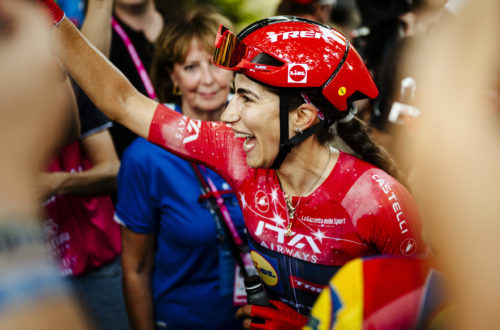
Lizzie Deignan spent more than 80 kilometers off the front of the peloton to win Paris-Roubaix in 2021. You couldn’t script a more staggering performance for the first women’s edition of cycling’s most storied one-day race.
In 2019, Trek became the first cycling brand to directly own a pro women’s sports team. Deignan was on that inaugural roster, and until her retirement in 2025 she was one of its most well-defined leaders. Her win on the mean, muddy cobblestones of Northern France reified Trek’s commitment to women’s cycling, and became emblematic of the teamwork and perseverance that define the squad.
“I think that on that day, what I remember was exactly just the emotion of the first time,” Luca said. “The picture I have in mind is the hug between the riders that day. That was nice, because as I said, we built up the women’s team with the aim to get strong immediately, and then we were successful at the first Roubaix.”

Lizzie Deignan winning the first ever women's Paris-Roubaix in 2021.
Question 2: What is your proudest accomplishment?
The Covid pandemic was Luca’s greatest challenge as General Manager. Cycling, like all sports, was operating under strict, makeshift conditions that could change at a moment’s notice. Races were moved or canceled. Riders or whole teams would suddenly have to be pulled from events. For someone for whom “manage” is his job title, the situation was a nightmare.
But the chaos bred opportunity. While some teams struggled financially, the team, then Trek-Segafredo, was able to keep paying salaries and bonuses to riders and staff. And the team performed well in the opportunities it had, including multiple classics wins across the men and women, and a spot on the podium at the Tour de France when Richie Porte finished third overall.
Luca and his staff kept riders engaged throughout the year with regular check-ins and at-home challenges that helped everyone feel connected during a difficult period. The commitment that team management showed towards riders and staff was repaid multiple times over in the years that followed by people who never forgot the kindness they were shown.
From each office, from all the riders, from everyone, then it was obviously a clear message that as I cared about them in the difficult time, they really all cared about me.
“I would say that from that point it was clear and evident that we felt the team really committed to the goals,” Luca said. “They were really, really committed to the team because we took care of them. So I think that, purely as a manager, was a huge success, in addition to creating this culture that is really committed to taking care of people the most.”
Luca felt personally repaid in 2021 after he revealed that he had been diagnosed with lymphoma. Trek-Segafredo riders and staff, as well as Trek employees around the globe, showed their support by donning “FORZA LUCA!” shirts to encourage him in his fight against the disease.
“From each office, from all the riders, from everyone, then it was obviously a clear message that as I cared about them in the difficult time, they really all cared about me,” Luca said.

Luca's close relationship and early success with Fabian Cancellara helped set Trek's road program in motion.
Question 3: What is your biggest regret?
Simple: “That’s really sport-related. That is the fact that we have not been able to have Mads [Pedersen] win a Monument.”
Luca calls Pedersen “the rider I respect the most in the matter of leadership.” And to be clear, Luca recognizes that Pedersen’s palmares is stuffed in many other ways: the 2019 World Championship, 11 Grand Tour stage wins, three Grand Tour overall points jerseys, and 10 one-day race wins alongside five Monument podiums. But a Monument win would be well overdue for a rider who is not only a phenomenal racer, but exemplifies the outspoken-yet-selfless leadership that Luca strives for himself.
“What I appreciate is that from his first years with the team when he was young, even when he won the World Championship, he has always been a guy who was inclined to listen to others, but also always express his own opinion,” Luca said. “He was never aggressive, always very straight and very clear. And when you calmly express your disappointment or your ideas to management, suddenly there’s mutual respect. Obviously sometimes I would have to say no to him in a very strong way, and he has always been very fair.”
I really hope he will win a Monument, whether I'm there or not, because he really deserves it.
Pedersen is not only one of the fastest riders in the world, but he has become an internal leader at Trek. His ability to give thoughtful, forthright feedback helped shape the Madone Gen 8 into one of the fastest bikes in the world. And when Luca has needed someone to maintain team cohesion during difficult times, he knew he could count on Pedersen.
“When there was a moment in which I needed to give a clear message to the whole group of riders, I knew that I could count on him and say, ‘OK, please deliver this message to your teammates, because they need to understand the team position,'” Luca said. “And he has always been in favor of helping the team more than himself.”
When the day comes that Pedersen finally tastes Monumental glory, Luca may not be running Lidl-Trek, but there won’t be a bigger fan anywhere in the world.
“I was there on site to see him win a World Championship, and so many big races,” Luca said. “And I really hope he will win a Monument, whether I’m there or not, because he really deserves it.”

Luca celebrating a great finish to the 2026 Giro d'Italia with Giulio Ciccone and Jonathan Milan.
Question 4: What was the greatest lesson you taught?
Being the head of a major road cycling team means making a lot of difficult decisions. But Luca never wanted to run a fiefdom. He encouraged collaboration and solicited feedback from everyone under his leadership, down to the junior mechanics.
“When you make a decision as a leader, you cannot expect that everybody’s happy. That’s clear, because you always have in mind the big picture. But at least you need to try to listen to everyone,” Luca said. “I think — at least I hope, I don’t know — I hope that this has been a message that I pass through to people, because I think that if everyone in a management position is fair and tries to use this kind of strategy in their decision process, I think that then the project will be successful, because everyone will feel like a real part of the mechanism that drives to the result.”
Luca recognizes that he runs an organization of human beings, not parts in a machine. They are driven by thoughts and emotions. Passion courses through the sport. Everyone who touches it is naturally driven to express themselves. And it’d be foolish to ignore those voices, not only for the insight they may carry, but for how it keeps the fire burning in the bellies of those doing the grueling day-to-day work that drives WorldTour programs.
“We are so lucky that we can do a job that can drive a lot of emotion, and the biggest emotion is the victory,” Luca said. “And I think that if you let the people feel, you can push people to be committed to the project, because at the end you can promise them that they will leave with this kind of emotion.”

Luca doing an interview in 2016.
Question 5: What was the greatest lesson you learned?
Luca recalled feeling overwhelmed when he was tabbed as the new General Manager for the road team. To this day, he’s not sure what Trek leadership saw in him as a young sports director. Even after all that he’s accomplished, Luca still feels like he’s trying to prove himself.
That’s not to say that Luca isn’t confident, but he’s also wary of too much self belief. To that end, he has always sought out mentors who could keep him grounded during good times, reminding him what to watch out for whenever he may have been tempted to let off the gas.
That drive came from taking a sense of ownership in the role. Luca remembers a visit from Trek President John Burke during Milan-San Remo. JB told Luca he liked his team bus, and Luca reminded him that, actually, the bus moreso belonged to JB and Trek than Luca and the team.
I think that if you let the people feel, you can push people to be committed to the project.
“He said, ‘No, no, this is your bus, this is your project. This is your bus, it’s not my bus,'” Luca said. “Then during the year with Trek, I discovered that that was true: this was my bus. And I needed to lead it as if it’s my own bus, whether it’s owned by JB, by Trek, or whatever.”
Despite the autonomy that Trek gave Luca to run the team, he never felt siloed from headquarters. Trek Vice President Roger Gierhart came to be one Luca’s biggest resources. He helped teach Luca the art of delegation — the difficult task in leadership of learning to let go and trust your people — and then demonstrated what grace and patience look like.
“I remember that his message was clear: ‘You call me if there’s a big issue, or a small issue. Just take care, move forward, I support you,'” Luca said. “I think that that’s a nice way to mature within the company, knowing that you have these kinds of people in front of you, because they can always be a reference, and you can aim to be as good as them.”

Luca in the middle of the his most recent squad of riders.
Question 6: What will you remember most about your time with Trek?
A decade-and-a-half has flown by for Luca. For someone who still feels like he’s learning the role, it seems strange that so many of his peers now reach out to him as a source of wisdom.
“If I see myself when I started, I was just studying to coach kids. My expectation was that. And then suddenly you realize that you are leading a company,” Luca said. “I don’t stop enough to think about these things, because I always try to be ambitious and go full gas. And I still will go in that direction, but that’s still something that sometimes I think. And it’s crazy how it happened so fast, because 12-13 years are a lot.”
It’s hard to retrieve moments from your memory. People are easier. Luca says he will miss the great people he met, especially those he had long, close working relationships with like Lidl-Trek Head of Coaching, Scouting & Academy Josu Larrazabal and Head of Sports Operations Elke Weylandt.
I really hope that the future is still very successful for the team, because that's the best reward that I can have. It would mean that I helped build something that can stand forever.
“A big thank you to everyone,” Luca said. “It was a long journey — so far, the longest professional journey in cycling with the same group of people, I would say. And it’s been a great journey. I learned a lot, and I’m happy to be part of that. And I really hope that the future is still very successful for the team, because that’s the best reward that I can have. It would mean that I helped build something that can stand forever.”
Luca’s next adventure will be revealed in time, but we already know exactly how he’ll approach it.
“When Trek asked me to be the manager of the cycling team, they asked, am I ready to do it? Yes. Do I have the know-how to do it? No, but let’s take the risk and put yourself in the condition to learn and take a new step in your life,” Luca said. “So I hope that this will be the same in my next future.”