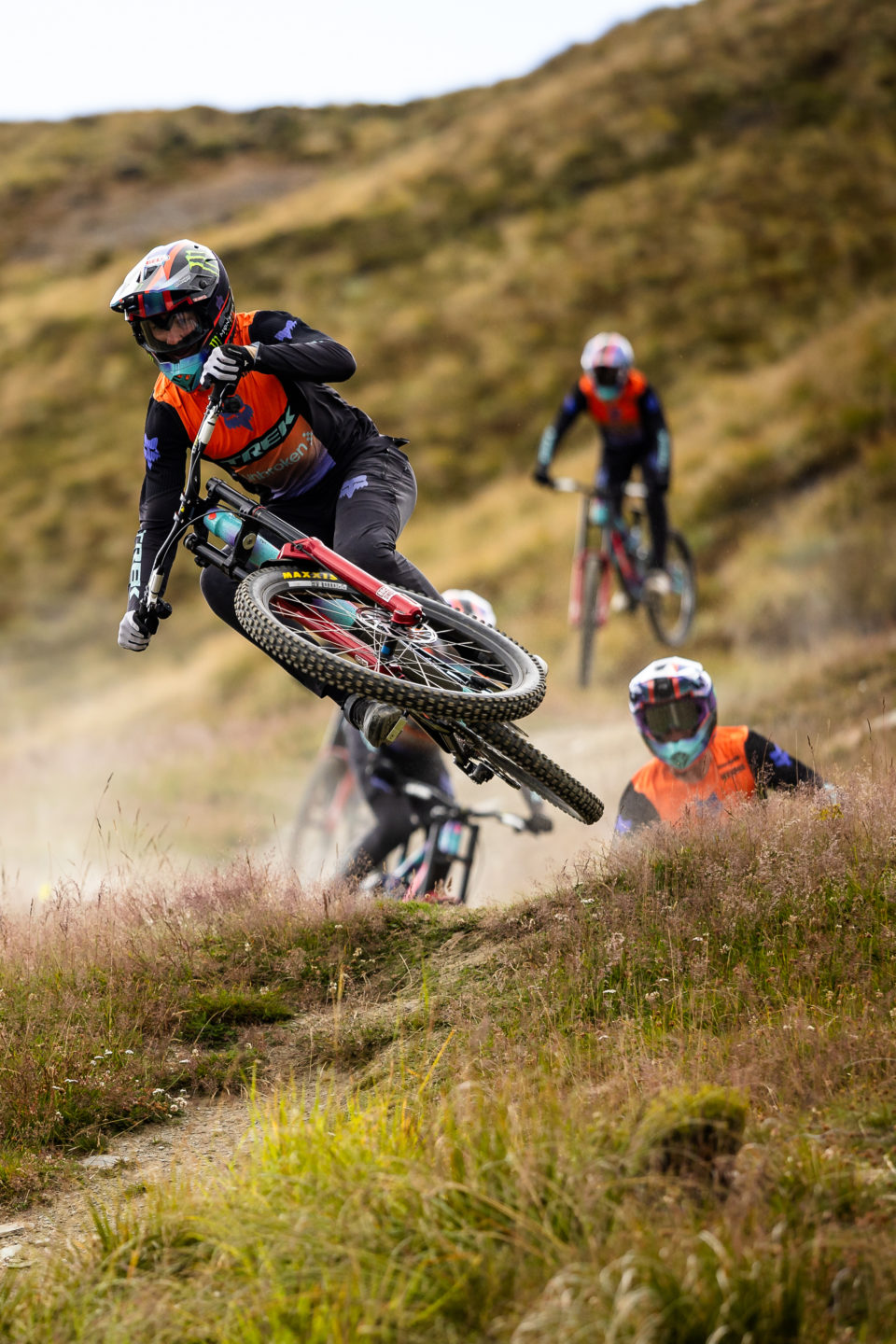

We're racing a prototype XC mountain bike. No we're not crazy. We want to tell you all about it.
Want to see a cool bike?
… what’s that? You’ve seen it? Erm, yes. Hard to miss
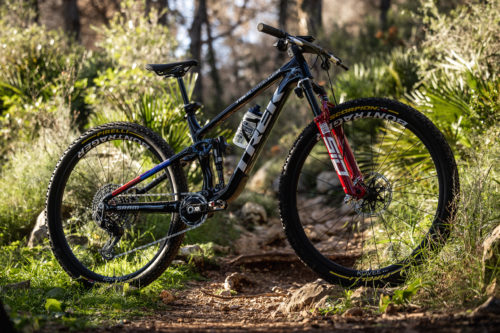
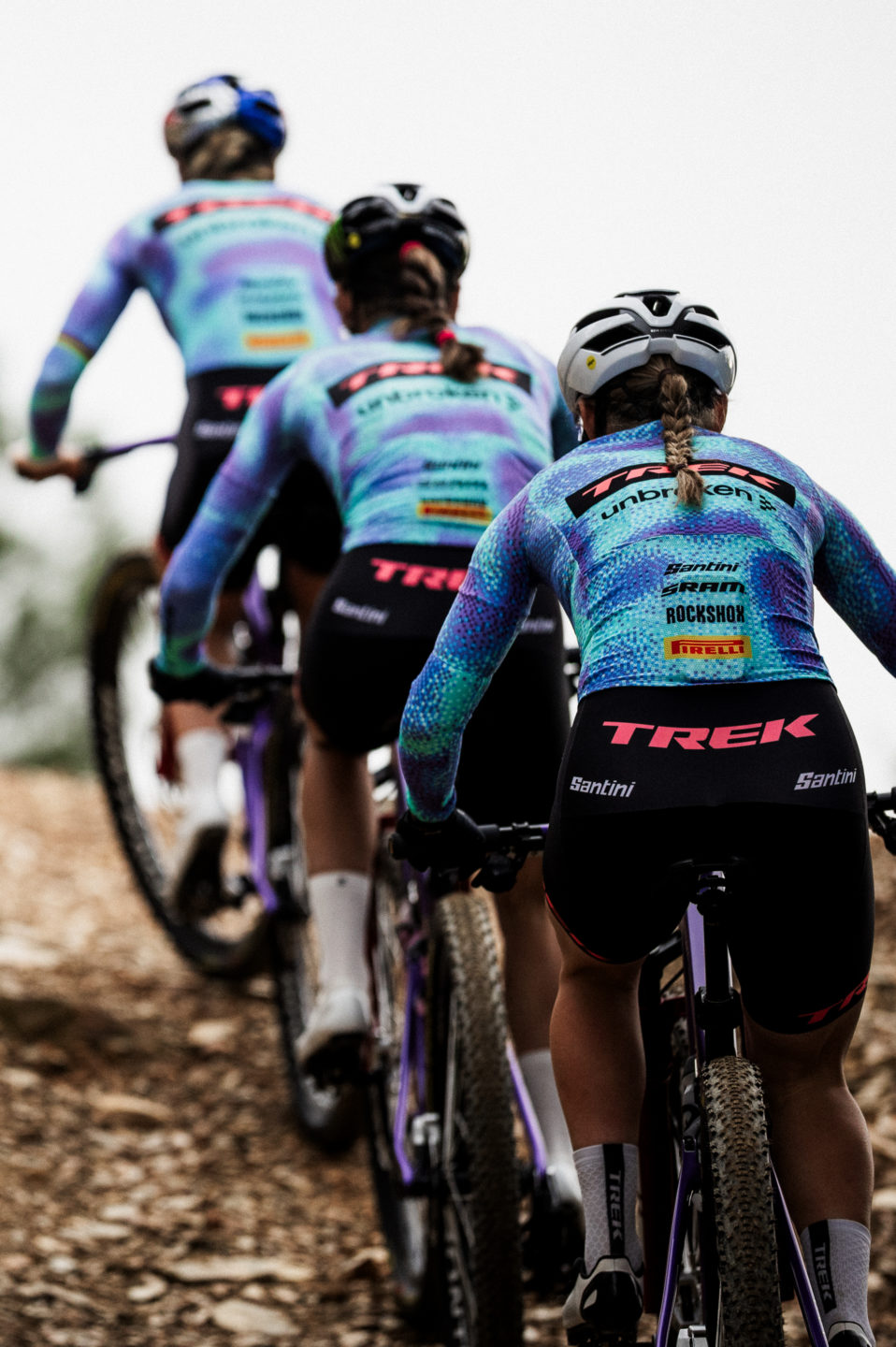
Trek-Unbroken XC’s prototype attracted a lot of attention at training camp and early season races. It definitely isn’t a Top Fuel or a Supercaliber. The lithe tubing, the hardly-shy purple paint job, the flex stay, and top tube-mounted shock are, collectively, a sharp departure from the rides that have aided the team’s success for nearly a decade.
The prototype bike is anything but “cookie cutter,” especially once you understand the ground-up development process Trek used to arrive at the frame design. Typically, big bike brands don’t like explaining the fine details of a bike that no one may have a chance to buy. Then again, prototype XC race bikes are a rare sight on the World Cup circuit to begin with. And in this case, Trek believes that outfitting some of the fastest mountain bikers in the world with the very fastest bikes it can make is instructive to the public at large.

No use hiding it now.
The prototype that Trek-Unbroken XC will be racing this season may never hit store shelves, but it was designed by the same engineers behind the company’s entire MTB fleet, using a meticulous process with all-World athletes and product testers that helped make bikes like Trek Supercaliber, Session, and Slash capable of winning World Championships, Olympic gold, and World Cup overall titles.
What the Trek-Unbroken XC squad accomplishes on the prototype this season will give Trek engineers a treasure trove of data and learning that it can apply to every bike they scheme up now and in the near future. In fact, after several years of development, the prototype already has helped shape the next generation of Trek mountain bikes. You may never ride this bike, but we promise you’ll be riding its influence in the future.
So, what is this thing? The story of the Trek-Unbroken XC prototype, and why we won’t let you ride it, starts with another cool bike — the Supercaliber — and how the world changed around it.

From raw ...

... to finished product.
The Supercaliber still rips. It will absolutely help you tear up your local XC series. But World Cup-level XC racing changed a lot in the years since Jolanda Neff and Evie Richards won Olympic gold and an XCO World Championship on the bike in 2021. The tracks got meaner. Rock features got bigger, gap jumps joined the party, and suddenly 80mm of travel wasn’t enough to thrive on the circuit. Last season, the team most often opted to race on the “downcountry” Top Fuel, which had 120mm of travel and, when paired with RockShox Flight Attendant, tested faster than Supercaliber on rough terrain, despite having a not-insignicant weight disadvantage.
The fact that Top Fuel performed so admirably as a stopgap is another testament to Trek engineering, but the best minds in Waterloo knew that the team needed a tailor-made solution as soon as possible.
Alex Martin was eager for the challenge. He’s a long-time Trek engineer who has been focused on XC bikes for roughly the last five years. He has a constantly-buzzing brain, and he was looking forward to sketching out what the next generation of Trek XC race bikes could look like even before work properly began on the prototype in January, 2024.
“Out of all our engineers, his mind works so fast,” Graham Wilhelm, Trek’s director of product development, said. “I think about it like when the Iditarod starts, and you got the dog in the front that’s just ready to go. That’s Alex. He’s just ready to go.”
We separated out that emotional aspect that I think as bike designers and product managers, sometimes that takes the front seat.
- Alex Martin, Trek MTB engineer
The design process was driven by data. The prototype could certainly incorporate characteristics of the Supercaliber and Top Fuel that riders liked — and indeed, there were aspects, like the Supercal’s geometry and fit, that the engineering team tried to recreate — but the bike would be a ground-up design if it needed to be. Just because those bikes worked so well in the past didn’t mean that they had to be the foundation for the future.
“We separated out that emotional aspect that I think as bike designers and product managers, sometimes that takes the front seat,” Martin said. “This was very much a data science approach.”
The mission statement was simple: Design the fastest 29-inch wheel, full suspension cross country mountain bike possible. No more, no less.
Step 1 was finding the best rear suspension layout. At first, Martin tested something like a modified Supercal, with a pivot added between the strut in the top tube and the frame. But the performance improvement was only marginal and couldn’t justify the weight increase, so the design was scuttled.

Dialing in rear suspension was Step 1 in a lengthy process.
Then the question became: What should the rear suspension look like? Trek’s patented Active Braking Pivot (ABP) technology is the go-to for Trek’s full suspension mountain bikes. The design allows the suspension to remain active while braking, providing even greater defense against major bumps at high speeds. However, while ABP works great for more than 99 percent of riders, including elite downhill racers racing World Cups on the Trek Session, it is a relatively weighty solution in the world of ultra-fast XC racing. Martin wanted to see how it would test against a simpler, lighter option: The flex stay, which does away with the ABP pivot at the rear axle in favor of a compliant rear triangle that helps keep the rear wheel planted.
Martin gathered a team of testers that included savvy Trek employees, but also Trek-Unbroken XC riders like Riley Amos, Gwendalyn Gibson, and Evie Richards. They would be involved in the development process from start to finish to make sure the final product was completely tuned to their needs.
Martin created a prototype flex stay, and had riders try it on test courses in Durango, Colo., and in Blue Mounds, Wisc., alongside ABP-equipped production Top Fuels. The flex stay was the preferred choice for an XC application, giving riders improved weight and performance while maintaining a desirable suspension for a bike that needs to perform well on the pedal above all.
“So that was a big one. If we want to do a different suspension layout and we want to have competitive weight, we had to have a flex stay bike,” Martin said.
If we want to do a different suspension layout and we want to have competitive weight, we had to have a flex stay bike.
- Alex Martin
With that, Martin and company had settled on the prototype’s essence: linkage-driven à la Top Fuel, with a flex stay and fit as close as possible to what Supercaliber achieved. “It needs to have suspension capability and control like a Top Fuel, but it needs to have the geometry of a Supercal,” Martin said. “And if we can combine both of those, we’re going to win.”
The engineering team set out to refine the bike, first by determining the best possible linkage system. They took an unorthodox next step and built carbon prototype parts. Normally prototypes are built out of aluminum because it’s cheaper and easier. But aluminum is also much heavier than carbon, and when trying to determine what’s best for an XC race bike, weight matters. Martin wanted the test bikes to move and feel as close to what riders would actually race at World Cups.
Martin settled on two linkage options: A “swing” link that hangs from the top tube, and a “flapper” link that looks much like a classic rocker link, but connects to a top tube-mounted shock. He created his carbon prototypes by taking production Top Fuels and bonding on suspension points to set up the different linkage systems. By testing on the known quantity of the Top Fuel, the engineering team could control as many factors as possible. The two different linkages were tested on bikes that had the same geometry and the same front end stiffness, and only minor differences in weight and rear end stiffness due to the linkages themselves.

The OG flapper link ...

... in its final form.
Martin set up a “shootout” in Durango — essentially, a side-by-side-by-side comparison of the prototypes against Trek’s production bikes, as well as competitors’ XC bikes. There was one clear winner: Riders felt more confident on the flapper prototype, and many of the testers preferred it to the polished, fresh-off-the-shelf bikes that had been brought to the test course. The results were tantalizing. The bike gave testers consistent, predictable support throughout the length of the travel. “OK,” Martin thought to himself, “now wait until we design a ground up version of this.”
The final version of the prototype notably settled on 115 millimeters of travel in the rear suspension, at a time when many competitor XC race bikes offer 120mm. Martin and the engineering team found that 115mm (not including the additional compliance of the flex stay) offered the best combination of performance and a sturdy pedaling platform, even with an open shock.
“We certainly could have done 120, but 115 combined all the kinematics and pedaling performance of the bike we wanted, without burdening the shock too much,” Chris Drewes, Trek’s global MTB product manager, said. “We wanted all the modes to be usable and efficient, which is really challenging. And so that’s where Alex worked tirelessly to get that leverage ratio right.”
We certainly could have done 120[mm of travel], but 115 combined all the kinematics and pedaling performance of the bike we wanted, without burdening the shock too much.
- Chris Drewes, Trek's global MTB product manager
The last step was making the lightest and most efficient frame possible. Martin turned to Trek’s structural analysis team, which ran simulations that showed how different sections of the frame — the top tube, the seat tube, the chain stays, etc. — strained under specific pedaling or stiffness loads. Based on whether sections of the frame were experiencing vertical, horizontal, or torsional (i.e., twisting) stress, the tube shapes could be strengthened or reshaped. The analysis also told engineers where extra material wasn’t needed on the frame, allowing them to make incremental weight savings.
The end product is a svelte package for a hardier XC race bike, tailor-made for today’s World Cup circuit. And the fact that Trek-Unbroken XC athletes were involved in testing from the jump strengthened Martin’s confidence in the bike.
He had wanted to design an XC mountain bike with greater rider involvement for some time, mirroring a process that Trek’s road engineers used to design the Madone, or that trail bike engineers used to design the prototype Sessions that Trek-Unbroken DH is racing. As World Cup XC racing gets increasingly more intense — both in terms of devilish course designs and cutthroat competition — it’s vital that riders feel confident that they’re racing the best equipment possible.
“This time, it was like, ‘we’re working with you every step along the way.’ And it was awesome to build trust between riders and the development team here,” Martin said.

Trek-Unbroken athletes were there for nearly every step of the development process.
Now we come to the question that has been perhaps gnawing at your brain: Why aren’t you selling this thing? It’s … honestly a pretty good question. The prototype is the fastest XC race bike Trek has ever made, full stop. We think it’s amazing, and if you had a chance to ride it, we think you’d love it, too. But the truth is, we’re not done yet.
While Trek-Unbroken XC riders may ultimately be the only people to enjoy the bounty of engineering ingenuity that went into this specific prototype, the spoils will filter out to the rest of the world in due time. The prototype is simply one step in a constantly-churning iterative process within the walls of Waterloo. You may not ride this bike, but rest assured that something even bigger and better is in the works.
“It shows our commitment to racing and developing high performing bikes. But I think it also shows a commitment to learning and trying new things, and just doing things differently than how anybody else is doing it. Actually testing things on the World Cup level, and then iterating,” Martin said. “And if we can solve problems for a World Cup rider, that’s going to help a problem that any other rider has.”
In short: Trek’s mission to make the fastest bike possible isn’t finished. Not even close. Stay tuned.